University of Oslo · 2025–2029
What is the purpose of responsible business?
In 2019 the British Academy and 181 American chief executives said within months of each other that a company exists to serve society, not only its shareholders. STAKES asks what that promise has been worth in the seven countries where it is hardest to keep.
The purpose of business is to solve the problems of people and planet profitably, and not profit from causing problems.Colin Mayer, Principles for Purposeful Business,
British Academy, London, 2019, p. 8
- Funder
- Research Council of Norway
- Project number
- 353416
- Scheme
- FRIPRO Researcher Project for Scientific Renewal
- Term
- 1 Jul 2025 to 29 Jun 2029
- Host
- Centre for Global Sustainability (GLOBE/SUM), University of Oslo
- Lead
- Jason Miklian
Featured research
All outputs →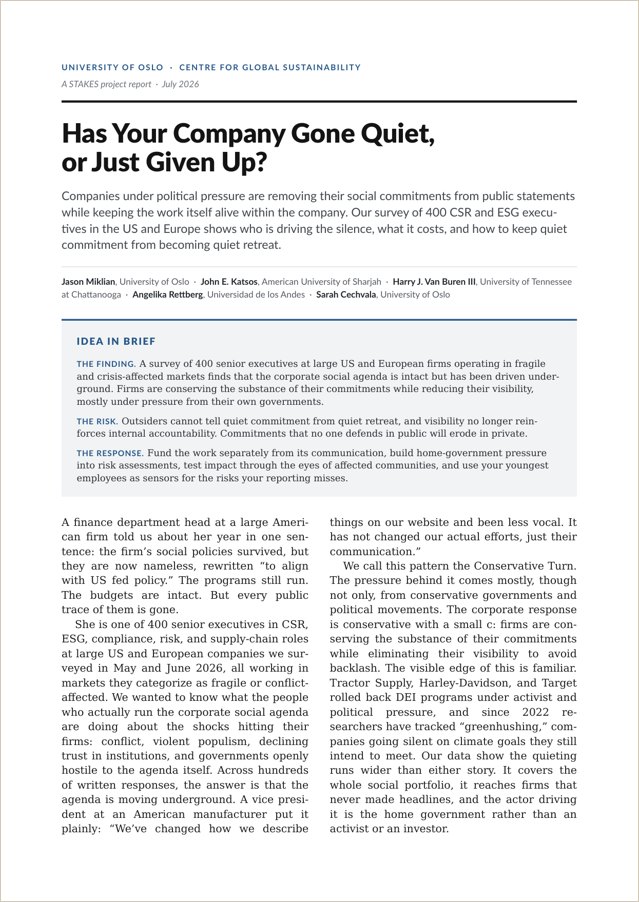
Project report · July 2026
Has Your Company Gone Quiet, or Just Given Up?
Under massive political and geopolitical pressures, companies are quietly stripping the visibility from their social activities. A survey of 400 CSR and ESG executives in both Europe and the USA shows why this silence matters, and what it costs companies now and in the future.
- The finding. A survey of 400 senior executives at large US and European firms operating in high-risk and crisis-affected markets finds the corporate social and environmental agenda intact, but driven underground. Firms are conserving the substance of their commitments while spending down their visibility, mostly under pressure from their own governments.
- The risk. Going quiet may be strategic but it carries long-term costs. Stakeholders cannot distinguish between quiet commitment and quiet retreat, while public visibility no longer reinforces internal accountability. Over time, this low-visibility environment can encourage commitments to gradually and quietly erode.
- The response. Managers should preserve social substance even when its visibility declines, but also build organizational capabilities for incorporating home-government pressures into risk assessments, capture and scale crisis management know-how, and bring younger employees into frontline decision-making as sensors for emerging social and political risks.
Also recent
The Quiet and the Compliant: How Regulation and Polarization Shape Conventional Wisdoms on Corporate Social Engagement in High-risk Settings
European professionals report far higher strategic integration of social impact than their US counterparts, and US professionals overwhelmingly say political polarization hinders their work. That perception does not predict unreported activity, which complicates the quiet CSR story.
A new digital divide? Coder worldviews, the ‘slop economy’, and democracy in the age of AI
A survey of Silicon Valley developers meets the 'slop economy': coders mostly recognise their products' power over democratic life, and face pressures that undermine it anyway.
The cases
All cases and their status →Bogotá · Meta · Cauca
A German industrial group bet on rural electrification after the 2016 accord. Then the cities burned.
Colombian firms paid farmers to leave coca and hired ex-combatants. Ten years on we ask whether the peace dividend reached anyone outside the project maps.
Beirut · Tripoli · Bekaa
A French drug company settled a bribery case in 2018. In 2022 it brought in 13,000 cholera vaccines.
Lebanese firms are woven into the parties and sects that govern where the state does not. This case follows what social repair looks like when a company is buying back trust it spent itself.
Bukavu · Goma · Kisangani
The brewery kept its trucks moving by paying armed groups. Then it wrote a human rights policy.
A Dutch parent company's Congolese subsidiary paid illicit taxes to rebel groups for years. We ask whether the policy that followed changed the conflict footprint or only the reporting.
Dhaka · Gazipur · Chattogram
Thirteen years after Rana Plaza, the buyer says its own subcontractors undercut the wage it promised.
A Swedish retailer has argued publicly for a living wage inside a sourcing structure that makes the wage unenforceable. The case asks whether one large buyer can move an industry it does not own.
Cabo Delgado · Palma · Maputo
A twenty billion dollar gas project promised jobs to Cabo Delgado. The insurgency arrived first.
What does an unmet corporate promise cost the people who believed it? Palma is where that question is sharpest, and where a company is managing the fallout of a presence that became part of the conflict.
Kyiv · Lviv · Dnipro
One company, two sides. Twenty million dollars invested in Ukraine, thirty million paid in Russian tax.
Business ethics scholars once argued that firms present on both sides of a war are the ones best placed to broker peace. Ukraine is where that argument meets a full-scale invasion.
North Sumatra · Riau · Jakarta
Can a plantation ever be responsible? Sumatra is where the EU deforestation rules meet the EU trade deal.
A German discount grocer is among Europe's largest buyers of Sumatran palm oil, on a seam where one EU regime restricts imports and EU trade negotiators work to expand them.
Indonesia · Philippines · Papua New Guinea · Solomon Islands · Malaysia · Timor-Leste
Four tuna species spawn in one sea shared by six countries. Europe buys the catch and sets many of the rules it is caught under.
The Coral Triangle is the nursery of the world's market tuna. This case follows one European buyer through certification, trade concessions and the conditions on the boats.

Who is doing this
Full team and reference group →University of Oslo
WP4 · Bangladesh · Indonesia
University of Oslo
WP3 · Mozambique · Coral Triangle
Universidad de los Andes
WP2 · Colombia
American University of Sharjah
WP1 · Ukraine
University of Tennessee at Chattanooga
American University of Sharjah
Lebanon
London School of Economics and Political Science (LSE)
DR Congo
London School of Economics and Political Science (LSE)
Political economy of conflict · Southeast Europe
Eight questions
- How do varied interpretations of business purpose influence corporate action in fragile societies?
- How are corporate social purpose initiatives understood and evaluated by local communities?
- How do European regulators set the corporate purpose agenda, and to what ends?
- What societal ventures do companies deliver, and how do they land on communities?
- What do CEOs, boards and country managers actually decide, and why?
- Where is the corporate purpose agenda gender sensitive, and where is it not?
- Can heightened social purpose improve a firm's strategy in fragile settings?
- What does an expanded stakeholder theory tell us about grand challenges?